Red-Teaming & Incident Response for AI Systems
If you are not attacking your own AI, someone else will. This is not a dramatic statement.
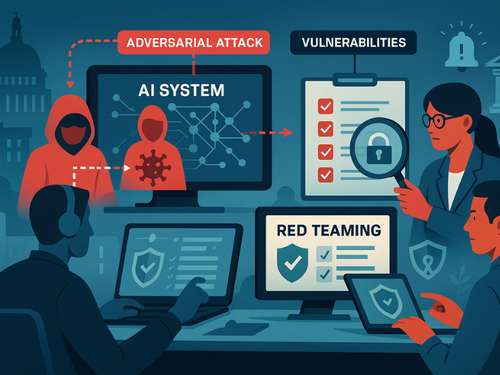
Red-teaming is the structured practice of attacking your own systems before adversaries do. In traditional cybersecurity, it has been standard practice for decades. For AI systems, it is still new territory for most organisations – and that gap is exactly where attackers are finding their footholds.
This article will explain what AI red-teaming actually involves, how to build incident response capabilities that are specific to AI, and what the regulatory obligations are when things go wrong.
1. Why Proactive AI Security Testing Is No Longer Optional
Quick answer:
Proactive AI red-teaming matters because AI systems fail in ways that traditional penetration testing does not surface. The failure modes are data-driven, probabilistic, and often invisible until exploited. A model that passes every benchmark can still be manipulated through crafted inputs, compromised through its training data, or extracted by systematic querying. Testing after deployment is not testing – it is waiting for the incident.
Traditional penetration testing is built around deterministic systems. You probe the network perimeter, test access controls, check for known vulnerabilities in software versions. AI introduces a fundamentally different surface.
An adversary does not need to breach your firewall to compromise your AI system. They can send it crafted inputs designed to produce wrong outputs. They can infer what data your model was trained on. They can systematically query a deployed model until they have reconstructed enough of its logic to replicate or manipulate it. None of these attacks involve your network perimeter at all.
This is why AI red-teaming has become a distinct discipline – and why frameworks like the NIST AI Risk Management Framework now explicitly address adversarial testing as a component of responsible AI deployment. For a deeper grounding in the threat categories, our article on AI security threats and the 2026 landscape covers the full taxonomy.
For regulated enterprises in Switzerland, Germany, France, and across the EU: The EU AI Act requires that high-risk AI systems be tested for robustness and resilience before deployment – and that testing capability be maintained throughout the system lifecycle. Red-teaming is not just good practice. For high-risk AI, it is a compliance obligation.
2. AI Red-Team Methodology
Quick answer:
AI red-teaming involves structured adversarial exercises targeting specific failure modes unique to machine learning systems: adversarial input crafting, data pipeline poisoning, model extraction attempts, and prompt injection. The methodology follows four phases – scope definition, threat modelling specific to the AI stack, adversarial testing execution, and findings analysis.
Effective AI red-teaming is not guesswork. It follows a structured methodology, adapted from traditional security testing but redesigned around the specific failure modes of machine learning systems.
Phase 1 – Define Scope and Threat Model
Start by selecting which systems to test and defining what threats are relevant. A credit scoring model in a Swiss bank has a different threat model from an internal document summarisation tool.
Threat modelling for AI should cover: who could attack this system, what they would want to achieve, and which attack vectors are available given the system’s architecture, data dependencies, and deployment context.
Phase 2 – Craft Adversarial Inputs
For language models, this means designing prompts specifically intended to break guardrails – causing the model to ignore its instructions, leak information it should not reveal, or produce outputs that serve the attacker’s goals. This is prompt injection testing at a systematic level.
For classification models – fraud detection, credit scoring, risk flagging – it means constructing inputs specifically designed to be misclassified.
Phase 3 – Simulate Supply Chain and Data Pipeline Attacks
Many AI red-teaming exercises focus only on the deployed model. The more impactful attack surface is upstream.
Red teams should probe whether training data sources can be influenced, whether data pipelines have validation gaps that could allow malicious data injection, and whether third-party data feeds introduce untested risk.
For more on how this connects to broader infrastructure risk, see our article on AI data infrastructure and compliance.
Phase 4 – Model Extraction Testing
Red teams should test whether rate limiting, anomaly detection on query patterns, and access controls are sufficient to make extraction attempts detectable and costly.
3. Tools and Frameworks for AI Red-Teaming
Quick answer:
AI red-teaming tools fall into three categories: open-source adversarial testing libraries, commercial AI security platforms, and regulatory frameworks that define what testing must cover. The most important framework is NIST’s Adversarial Machine Learning guidance (NIST AML 100-4), which provides taxonomy and testing methodology aligned with the risk management requirements of the EU AI Act.
Open-Source Tools
- Microsoft PyRIT (Python Risk Identification Toolkit) – purpose-built for LLM red-teaming, designed to automate adversarial prompt generation and evaluate model responses at scale.
- IBM’s Adversarial Robustness Toolbox (ART) – a comprehensive library for testing adversarial robustness across classification, detection, and generative models.
- Garak – an open-source LLM vulnerability scanner that probes for prompt injection, data leakage, hallucination under adversarial conditions, and jailbreaking susceptibility.
- Counterfit – a command-line tool from Microsoft for security testing of AI systems, including black-box adversarial attack simulation.
Commercial Platforms
Commercial offerings from vendors such as Protect AI, Robust Intelligence, and HiddenLayer provide integrated AI security posture management with automated red-teaming capabilities, model scanning, and continuous monitoring.
Regulatory Frameworks
NIST’s Adversarial Machine Learning (AML) taxonomy (NIST AML 100-4, published 2024) provides the most comprehensive framework for classifying AI attack types and mapping testing requirements. The EU AI Act’s technical documentation requirements align closely with NIST AML categories.
4. Incident Response for AI Systems
Quick answer:
AI incident response requires a framework that goes beyond traditional IT incident response. When an AI system is compromised – through adversarial manipulation, data poisoning, or model theft – the response must address not just the technical containment, but the model state, the data integrity, and the downstream decisions that may have been corrupted. Without extensive logging from the outset, forensic analysis of AI incidents is nearly impossible.
Most enterprise incident response plans were built for deterministic systems. A server is compromised, you isolate it, you patch it, you restore from backup. AI incidents do not follow this pattern.
A data poisoning attack may have been active for months before detection. The model’s corrupted behaviour is embedded in weights that cannot simply be “patched” – the model must be retrained on verified data.
Decisions made during the period of compromise may need to be reviewed and potentially reversed. And without logging infrastructure that captured model inputs, outputs, and versions throughout the period, none of this analysis is possible.
Detection: What to Monitor
- Distributional shifts in model inputs – unexpected changes in the data the model is receiving at inference time.
- Output distribution anomalies – when a model’s outputs begin to deviate from historical patterns in statistically significant ways.
- Query pattern anomalies – systematic probing of a model consistent with extraction or boundary-testing behaviour.
- Performance metric degradation – drops in accuracy, precision, or fairness metrics across demographic groups.
- Data pipeline integrity alerts – validation failures at ingestion, unexpected schema changes, or anomalous data sources.
Classification: Incident Severity
Not all AI incidents carry the same risk. A useful three-tier classification:
- Tier 1 (Critical): Active manipulation of high-risk AI system outputs affecting regulated decisions (credit, healthcare, insurance). Immediate containment required. Regulatory notification likely required within 24-72 hours.
- Tier 2 (Significant): Evidence of model extraction, data poisoning, or sustained adversarial probing without confirmed output manipulation. Investigation required; containment measures activated.
- Tier 3 (Monitored): Anomalous behaviour within expected variance; no evidence of malicious intent. Enhanced monitoring; no escalation unless pattern persists.
Containment and Forensic Analysis
Containment for AI incidents typically involves: isolating the affected model from production traffic, freezing the model state and all associated data snapshots, activating fallback logic or human review for decisions the model was handling, and preserving all logs for forensic analysis.
Forensic analysis requires being able to reconstruct which model version was in production at which time, what data it was trained on, and what inputs it received around the time of the suspected incident. This is only possible with the logging and versioning infrastructure described in our article on why enterprise AI fails in production. Without it, forensic analysis of AI incidents is largely guesswork.

5. Building an AI Security Culture
AI Security Champions
The AI security champion model works on a simple principle: embed security accountability in the teams that build and operate AI systems, rather than relying entirely on a centralised security team to catch problems after the fact.
Champions do not need to be security specialists. They need to understand enough about AI-specific risks to ask the right questions during development and deployment decisions.
In practice, this means: one engineer or technical lead per AI-owning team who is trained on AI threat categories, participates in red-teaming exercises, and serves as the first escalation point when anomalies are detected. They are not the security team – they are the security team’s eyes and ears inside the product team.
Regular Training and Awareness
AI security training needs to be different from general cybersecurity awareness. Developers need to understand prompt injection vulnerabilities in the systems they build. Data engineers need to understand what data poisoning looks like at the pipeline level. Product managers need to understand that a model’s benchmark performance does not predict its adversarial robustness.
Escalation Channels and Tabletop Exercises
Clear escalation paths matter. When a data engineer notices an unusual pattern in a training dataset, they need to know immediately who to tell and what happens next. When a security alert fires on a model’s query patterns, there needs to be a defined response path that does not require navigating organisational uncertainty under pressure.
Running regular tabletop exercises – structured simulations of AI security incidents – builds that muscle memory before a real incident demands it. The scenarios worth simulating: a data poisoning discovery, a suspected model extraction attempt, an LLM producing outputs that suggest successful prompt injection, and a privacy breach through membership inference.

6. Regulatory Reporting: When and What You Must Disclose
Quick answer:
Under the EU AI Act and GDPR, AI security incidents involving high-risk systems and personal data carry mandatory reporting obligations. The EU AI Act requires providers of high-risk AI to report serious incidents to national market surveillance authorities – with timelines aligned with DORA’s ICT incident reporting requirements of initial notification within 4 hours and full report within 72 hours for significant incidents. GDPR’s 72-hour breach notification applies when personal data is involved.
The intersection of AI security incidents with regulatory reporting is where many organisations are least prepared. Understanding the obligations before an incident occurs – not during one – is essential.
EU AI Act Incident Reporting
Providers of high-risk AI systems are required to report serious incidents – defined as incidents that cause or risk causing death, serious harm to health, significant disruption of critical services, or violations of fundamental rights – to the relevant national market surveillance authority. The reporting obligation applies from August 2, 2026 for high-risk AI systems in financial services, healthcare, and other covered domains.
DORA and ICT Incident Reporting
For financial institutions operating under DORA, AI systems are classified as ICT systems – which means significant ICT incidents, including AI security incidents, must be reported to the competent authority within 4 hours of classification as significant, with a full report within 72 hours. BaFin, FINMA, and ACPR are all enforcing these timelines.
GDPR and Data Breach Notification
Where an AI security incident involves the compromise of personal data – training data exfiltration, membership inference attacks that reveal information about individuals in the training set, or prompt injection attacks that expose user data – GDPR’s 72-hour breach notification obligation applies to the relevant data protection authority, with notification to affected individuals where there is high risk to their rights.
GDPR compliance does not satisfy the EU AI Act. For high-risk AI incidents involving personal data, both frameworks apply simultaneously and independently. Fines under each are separate and can stack.
How IMT Solutions Supports AI Red-Teaming and Incident Response
Red-teaming AI systems is not a checkbox activity. It requires understanding the specific architecture of the system being tested, the threat environment it operates in, and the regulatory context that governs how incidents must be handled.
IMT Solutions has worked with organisations across fintech, banking, insurance, and healthcare to design and deliver AI security testing programmes that connect adversarial testing to governance, compliance, and incident response.
Explore our case studies to see how IMT Solutions has supported organisations building secure, resilient AI systems, or contact IMT Solutions to speak with our team about your specific environment.
Frequently Asked Questions
What is AI red-teaming?
AI red-teaming is a structured adversarial testing practice where security specialists attempt to compromise an AI system using the same techniques real attackers would use – crafting adversarial inputs, probing for prompt injection vulnerabilities, testing data pipeline integrity, and attempting model extraction. The goal is to identify and fix vulnerabilities before they are exploited in production. Unlike traditional penetration testing, AI red-teaming must account for the probabilistic, data-driven nature of machine learning systems.
How is AI incident response different from traditional IT incident response?
AI incident response differs from traditional IT incident response primarily by addressing probabilistic systems and entirely new attack vectors. While traditional IT handles deterministic, rule-based systems, AI introduces dynamic model behaviors and threats like prompt injection, data poisoning, and model theft, requiring completely different detection telemetry and remediation strategies
When must AI security incidents be reported under the EU AI Act?
Providers of high-risk AI systems must report serious incidents – those causing or risking death, significant health harm, disruption of critical services, or violations of fundamental rights – to the relevant national market surveillance authority. For financial institutions under DORA, significant ICT incidents (including AI incidents) require initial notification within 4 hours and full reporting within 72 hours. Where personal data is involved, GDPR’s independent 72-hour breach notification obligation also applies.
What are the best tools for AI red-teaming?
Open-source options include Microsoft’s PyRIT for LLM red-teaming, IBM’s Adversarial Robustness Toolbox for classification model testing, and Garak for LLM vulnerability scanning. Commercial platforms from vendors including Protect AI, Robust Intelligence, and HiddenLayer provide integrated AI security posture management with automated red-teaming and continuous monitoring.
Does the EU AI Act require red-teaming for high-risk AI systems?
The EU AI Act requires that high-risk AI systems demonstrate robustness against attempts to alter their use, outputs, or performance by unauthorised parties – and that this robustness be maintained throughout the system lifecycle, not only at deployment. This requirement maps directly to what red-teaming is designed to test.